


"Flower Guardian" Successfully Lands in Mongolia
Recently, a consignment of flowers packed in anhydrous gypsum cartons developed by Guizhou Phosphate Chemical Group (GPC) has arrived in the Mongolian market. After thousands of kilometers of cross-border cold-chain transportation, the flowers maintained intact shape and quality thanks to the outstanding protective performance of the phosphorus gypsum-based green packaging. This marks the official entry of GPC’s anhydrous gypsum cartons into the export packaging track for fresh produce in cold chain, representing another major application breakthrough in the resource utilization of phosphogypsum.
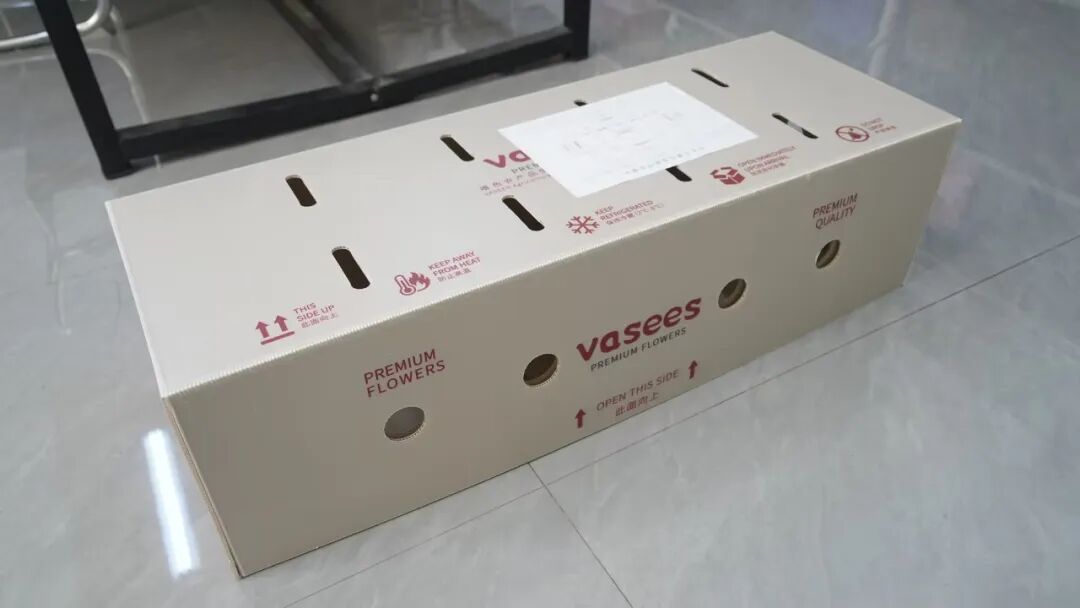
As a time-sensitive and perishable fresh commodity, flowers impose stringent requirements on packaging in terms of water and moisture resistance, compression and shock absorption, as well as preservation protection. Traditional paper cartons are prone to dampness and deformation caused by condensed water generated by temperature differences during long-distance cross-border cold-chain transport. Their insufficient compressive strength may lead to product squeezing under multi-layer stacking, which is a common industry challenge contributing to high loss rates in fresh produce exports. The self-developed anhydrous gypsum carton by GPC is mainly made of converted calcium refined through deep processing of phosphogypsum, compounded with polymer resin materials. It is manufactured via multiple processes including granulation, sheet extrusion, printing and die-cutting. Boasting excellent properties such as water & moisture resistance, insect resistance, impact resistance and anti-aging performance, the product can retain structural integrity even after water immersion, with physical strength far exceeding conventional cartons. It serves as a reliable protective barrier for fresh goods transported over long cross-border distances.
"After departure from China, this batch of flowers traveled northwards via cross-border cold-chain routes to Mongolia. The cartons remained intact throughout transit. The firmness of flower buds and condition of leaves fully met customer expectations. The client plans to adopt our cartons to expand export markets such as Russia in the future," said the person in charge of the Sichuan-Chongqing Sales Division of GPC Green Environmental Protection. The water and moisture resistance of anhydrous gypsum cartons effectively solves the problem of condensed water erosion caused by temperature fluctuations in cross-border cold-chain transport. Its high compressive strength protects flowers from extrusion and deformation under multi-layer stacked transportation, greatly cutting loss rates in logistics.
In recent years, GPC has thoroughly embraced the green development philosophy and driven phosphogypsum resource utilization through technological innovation. The Group has built the world’s first demonstration production line for anhydrous gypsum masterbatch and hollow board cartons with an annual output of 25,000 tons. Calculations show that every ton of phosphogypsum consumed by this product can save approximately 0.8 to 1.1 tons of timber logging, realizing the value transformation of industrial by-products from an "ecological burden" to a "green treasure".
From securing its first overseas order in Australia to supporting flower exports to Mongolia, the application scenarios of GPC anhydrous gypsum cartons keep expanding, with steadily rising market recognition. At present, aligned with the 15th Five-Year Plan, GPC continues to deepen the industrial chain layout for comprehensive phosphogypsum utilization. Going forward, centered on scientific and technological innovation, the Group will leverage its green product matrix including anhydrous gypsum cartons to serve the Belt and Road Initiative and the New International Land-Sea Trade Corridor. It will provide high-quality green packaging solutions for more characteristic agricultural products entering global markets, contributing GPC’s strength to advancing the green and low-carbon transition of industries and boosting the development of local export-oriented economy.


