


Phosphorus-Titanium-Iron-Lithium Coupled Circulation Integrated Project Helps GPC Foster New Quality Productive Forces
“The site leveling works for Phase I of the project are nearing completion, marking the official acceleration of main construction.” In October, the construction site of the Phosphorus-Titanium-Iron-Lithium Coupled Circulation Integrated Project in Shuangyong Village, Shuangliu Town, Kaiyang County was bustling. Excavators stretched their booms and operated in order, while construction transport vehicles shuttled back and forth.
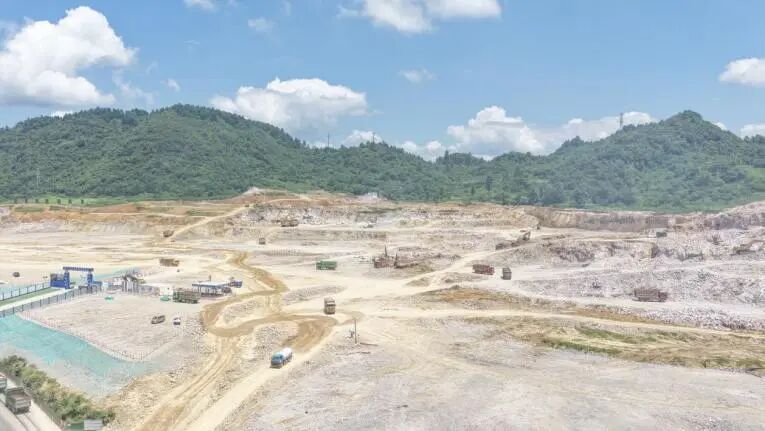
As introduced, the project serves as a key initiative of Guizhou Phosphate Chemical Group (GPC) to make inroads into new energy materials, with a total investment of 33.1 billion yuan. Through systematic exploration featuring full-resource development, full-industry-chain circulation and innovation across all factors, the project will provide a vivid example for fostering new quality productive forces in traditional resource-based industries. Once fully completed, it will grow into one of Southwest China’s largest production bases for phosphorus-based cathode materials.
At present, with the booming new energy materials sector, the risk of homogeneous competition for end products such as lithium iron phosphate has become prominent. Relying on multi-element resources including phosphorus, sulfur, titanium, copper, iron, lithium and fluorine, the project plans to build production facilities including 1.4 million tonnes of ferrous sulfate heptahydrate co-produced with 400,000 tonnes of titanium dioxide, 600,000 tonnes of lithium iron phosphate and 20,000 tonnes of lithium hexafluorophosphate. It will form an industrial matrix featuring full-chain coupling, symbiosis and coordinated development.
“This plan breaks away from the traditional model of merely developing phosphorus resources, extending single-resource advantages into multi-element industrial strengths.” Closely following the central government’s guidance on “improving the comprehensive development and utilization of key mineral resources”, the project conducts in-depth development of phosphate ore as a carrier of multiple strategic resources. It avoids redundant construction caused by crowded market entry and ensures the independence and controllability of the industrial and supply chains for new energy materials from the source.
“The philosophy of circular economy has been embedded in the project from the design stage, building a closed-loop system for cascading resource utilization and internal consumption of by-products.” In terms of project operation, sulfuric acid produced from phosphogypsum decomposition feeds back into phosphoric acid production. Ferrous sulfate, a by-product of titanium dioxide manufacturing, is directly used as raw material for lithium iron phosphate. Fluorine resources, accounting for only 3% of phosphate ore content, are recovered via special technologies and processed into lithium hexafluorophosphate, the core electrolyte material for lithium batteries. The by-product of one process becomes the raw material for another. This model greatly raises the comprehensive resource utilization rate, exploring a replicable path for the green and low-carbon transition of the chemical industry, and offering practical reference for resource-based industries to resolve the dilemma between environmental protection and development.
The development and delivery of this “Three-Full” project are underpinned by GPC’s long-term technological accumulation — from breaking foreign monopolies with purified wet-process phosphoric acid technology to achieving a world-first in the recovery of fluorine associated with phosphate ore. Innovatively integrating multiple patented technologies of GPC into every production link, the project overcomes a series of key technical bottlenecks such as associated resource extraction and large-scale phosphogypsum decomposition.


