


GPC‑affiliated Heilongjiang Wengfu Renhe Rice Industry Earns Another National‑level Honor
Recently, the National Joint Committee on Agricultural Industrialization released the results of its annual dynamic monitoring. After rigorous review and comprehensive evaluation, Heilongjiang Wengfu Renhe Rice Industry under GPC, has successfully renewed its title as a National Key Leading Enterprise in Agricultural Industrialization. Its comprehensive strength, industrial capacity and social responsibility have once again received authoritative national‑level recognition.
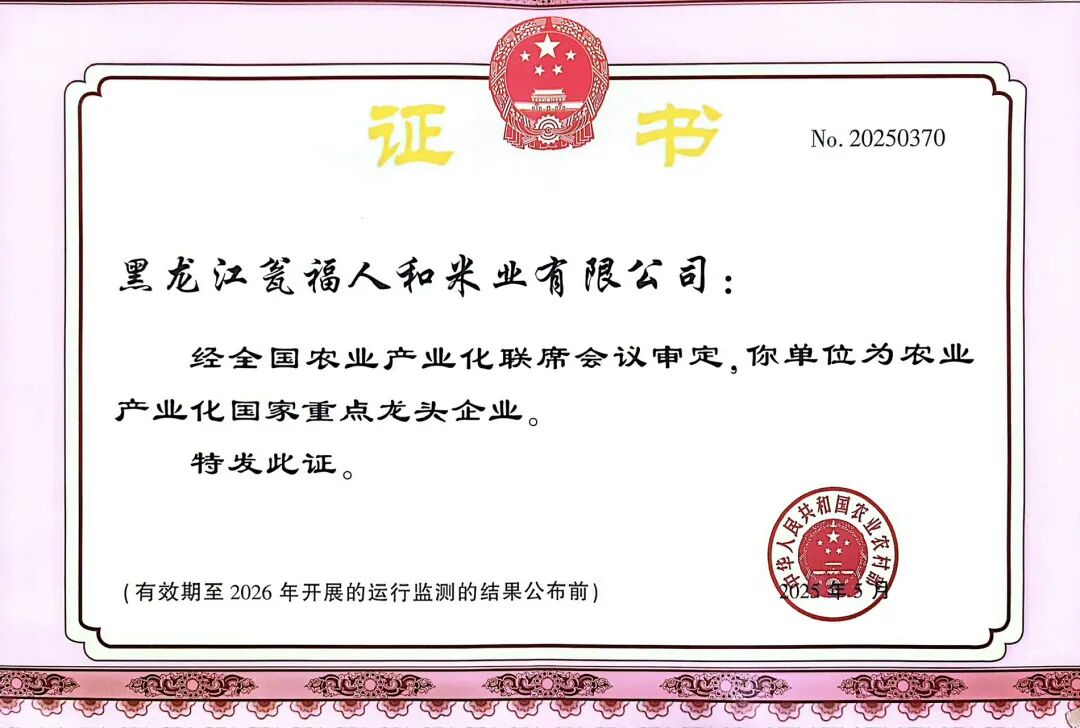
Rooted in the fertile black soil of cold‑climate regions, the enterprise focuses on its core rice business. As a National Key Leading Enterprise in Agricultural Industrialization, Renhe Rice Industry leverages local high‑quality rice resources and has built a complete industrial chain covering grain procurement, storage and drying, intensive‑processing and brand‑oriented sales. By continuously upgrading intelligent production equipment and standardized management systems, the company has fostered systematic competitiveness in key links including quality control, product traceability and green processing, and strictly safeguards food safety from farmland to dining tables. Meanwhile, giving full play to its role as a leading enterprise, it drives the upgrading of regional rice industry and increases farmers’ income, earnestly shouldering dual responsibilities for food security and industrial revitalization.
From “a single grain of rice” to “a full‑fledged industrial chain”, Renhe Rice Industry always takes standards as its yardstick and quality as its foundation, and keeps consolidating the brand value featured by cold‑climate black‑soil agriculture. This successful re‑qualification through annual monitoring represents both recognition and greater accountability.
Going forward, Renhe Rice Industry will further consolidate its industrial foundation, advance the dual‑driven strategy of scientific‑technological innovation and brand building, boost quality and efficiency of local rice industry, and make greater contributions to rural industrial revitalization and high‑quality development of modern agriculture.


